
The molding process of injection molded foamed polyurethane products
Release time:2025-05-22 19:11:37 author:Xingtaiyourui Click through rate:144
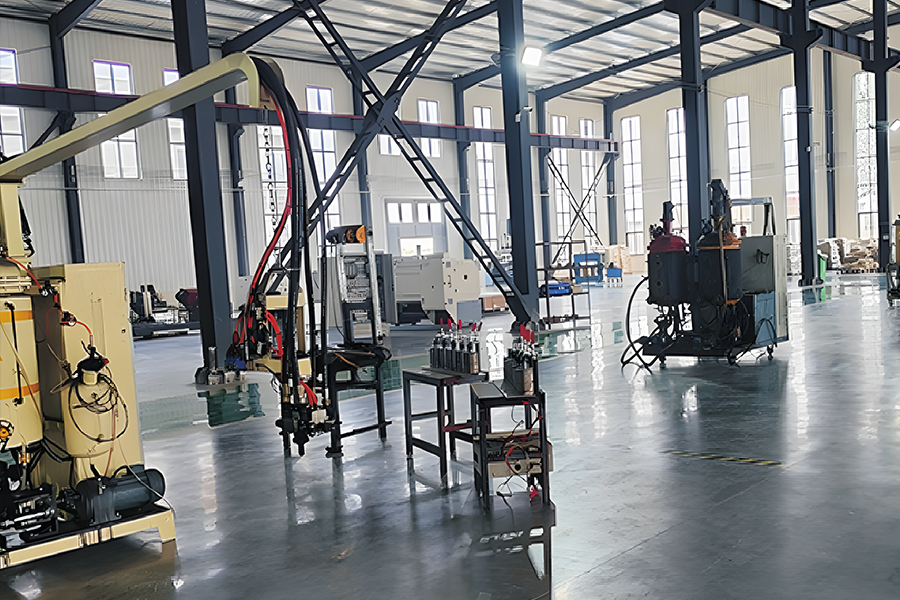
Injection molded polyurethane (PU) products are a process that combines injection molding and foaming technology, mainly used to produce lightweight, precision appropriate, and complex shaped foam products. Its core is to inject polyurethane raw materials into the mold through an injection molding machine, and undergo chemical reactions (or physical foaming) in the mold cavity to form a microporous structure. The following is the detailed process and key control points of the technology:
1、 Classification of molding processes for injection molded foam PU
1. Chemical foaming method
Principle: Use isocyanates (- NCO) to react with polyols (- OH) to generate CO ₂ gas for foaming, or add chemical foaming agents (such as NaHCO3) to decompose and produce gas.
Features: Uniform pores, suitable for high-density microporous products (such as shoe soles and car interiors).
2. Physical foaming method
Principle: Inject supercritical fluid (such as N ₂, CO ₂) or low boiling point solvent (such as pentane), and expand and foam through pressure release.
Features: No chemical residues, good environmental friendliness, suitable for food packaging and medical materials.
3. Reaction Injection Molding (RIM)
Principle: Mix isocyanates and polyols under high pressure, inject them into the mold at a suitable speed, and foam and cure them (such as car dashboard).
Features: Short molding cycle, suitable for large complex parts.
2、 Injection molding foam PU process flow
1. Raw material preparation
Component A: Isocyanates (such as MDI, TDI).
Component B: Polyol (polyether/polyester type)+Catalyst (amine/organic (based on actual reports) tin)+Foaming agent (chemical or physical)+Stabilizer (silicone oil).
Pre mixing: Component B needs to be homogenized and mixed to avoid bubble defects.
2. Injection molding
High pressure injection: The A/B components are mixed at high pressure (10-20MPa) using an injection molding machine and injected into the mold.
Mold temperature control: The mold temperature is usually between 40-80 ℃, which affects the foaming rate and curing time.
Foaming stage:
Chemical foaming: CO ₂ gas causes the material to expand and fill the mold cavity.
Physical foaming: Micro pores are formed after supercritical fluid depressurization.
3. Curing and demolding
Curing time: 30 seconds to 5 minutes (depending on product thickness and multiple regions).
Mold extraction: After cooling and shaping the foam, demold it to avoid deformation.
4. Post processing
Maturity: Leave at room temperature for 24 hours to fully react (improve mechanical properties).
Edge trimming: Remove burrs or residual sprues. 4、 Typical Applications and Cases
Automotive components: steering wheel, door panel core material (density 200-400 kg/m ³, weight reduction of 30%).
Shoe material: ETPU popcorn sole (supercritical CO ₂ foaming, excellent elasticity).
Electronic packaging: shock-absorbing cushion (closed cell structure, impact resistant).
Appliance shell: Lightweight insulation panel (such as air conditioning shell).
5、 Technological advantages and challenges
Advantages:
Lightweight: The product density can be reduced by 10-50%.
Design freedom: Complex geometric shapes can be formed in one go.
Energy saving: Closed mold foaming reduces raw material waste.
Challenge:
Bubble control: It is necessary to prevent bubble merging or collapse (mainly by adding nucleating agents).
Surface quality: Secondary processing (such as film coating) may be required to mask surface pores.
Equipment cost: High pressure injection molding machines and molds require high precision.
Other information
-
Differences in Performance between Polyurethane Soft Foam and Hard Foam
The performance differences between polyurethane soft foam and hard foam are mainly reflected in their molecular structur...
-
What should I do if there are uneven bubbles during the polyurethane foaming process?
The problem of uneven bubbles during the polyurethane foaming process directly affects key indicators such as insulation,...
-
Aging mechanism of polyurethane foam materials
The aging of polyurethane (PU) foam materials is a complex process involving multiple factors, including chemical structu...
-
The molding process of injection molded foamed polyurethane products
Injection foaming polyurethane (PU) products are a process combining injection molding and foaming technology, mainly use...
-
The application industry of polyurethane foam materials
Polyurethane foam materials are widely used in multiple industries due to their excellent properties such as lightweight,...